Showing posts with label Personal Finance. Show all posts

Sunday, January 5, 2025

Unlock Your Financial Potential: A Personal Finance Guide for Indians

In today’s fast-paced world, managing money effectively has become more crucial than ever. Personal finance isn’t just about saving money; it’s about making informed decisions to secure your future while enjoying the present. For Indians, with our unique financial landscape and cultural nuances, mastering personal finance can unlock the door to a life of stability and growth.

What is Personal Finance?

Personal finance encompasses everything related to managing your money—from earning and spending to saving and investing. In India, where family dynamics and cultural traditions often influence financial decisions, personal finance also includes planning for joint family expenses, education, and weddings. It’s about balancing your present needs with future goals, ensuring that every rupee is well-utilized.

Key Components of Personal Finance

1. Budgeting: The Foundation of Financial Health

Budgeting helps you track your income and expenses, ensuring you don’t overspend. A popular method is the 50/30/20 rule:

  • 50% for essentials (rent, groceries, utilities).
  • 30% for discretionary spending (entertainment, dining out).
  • 20% for savings and investments.

Pro Tip: Use apps like Walnut or ET Money to monitor your expenses automatically.

2. Saving: Building Your Safety Net

Savings act as a cushion during emergencies. Aim to build an emergency fund equivalent to 3-6 months of your monthly expenses. Utilize high-yield savings accounts or fixed deposits to grow your savings.

Pro Tip: Automate savings through recurring deposits or systematic investment plans (SIPs).

3. Investing: Growing Your Wealth

Investing is crucial for long-term financial growth. Explore these popular options in India:

  • Mutual Funds: Start with SIPs for disciplined investing.
  • Stocks: Invest in equity for higher returns but higher risks.
  • Real Estate: A preferred option for many Indians, especially for long-term gains.
  • Gold: A traditional favorite, now accessible via digital platforms.

Pro Tip: Use platforms like Zerodha or Groww for seamless investing.

4. Insurance: Securing Your Future

Insurance is your safety net against unforeseen events. Essential types include:

  • Health Insurance: Covers medical emergencies.
  • Life Insurance: Provides financial support to your family in case of your absence.
  • Term Insurance: Offers high coverage at a low cost.

Pro Tip: Compare policies on platforms like Policybazaar to find the best deals.

5. Debt Management: Staying in Control

Avoid high-interest debts like credit cards. If you have loans, prioritize paying off high-interest ones first. Consider consolidating debts to simplify repayment.

Pro Tip: Always pay your credit card bills in full to avoid hefty interest charges.

Unique Financial Opportunities in India

1. Government Schemes

  • PPF (Public Provident Fund): A long-term, tax-saving investment with attractive interest rates.
  • NPS (National Pension System): Helps you build a retirement corpus.
  • Sukanya Samriddhi Yojana: A savings scheme for the girl child.

2. Tax-Saving Instruments

Under Section 80C, you can save taxes through investments like ELSS funds, PPF, and insurance premiums.

3. Emerging Investment Trends

Consider these new-age investment options:

  • Digital Gold: Invest in gold without physical storage hassles.
  • Startups: Platforms like AngelList allow you to invest in emerging businesses.

Personalized Tips for Different Demographics

1. Students and Freshers

Start building a savings habit, even if it’s a small amount. Learn about investing basics and explore SIPs.

2. Mid-Career Professionals

Focus on balancing expenses with wealth creation. Diversify your investments to include mutual funds, stocks, and real estate.

3. Retirees

Shift focus to wealth preservation. Invest in low-risk options like fixed deposits or government bonds. Ensure adequate health insurance coverage.

Practical Tools and Resources

Mobile Apps

  • Walnut: Tracks expenses.
  • ET Money: Manages investments and expenses.

Investment Platforms

  • Zerodha: For stock trading and mutual funds.
  • Groww: Simplifies mutual fund and stock investments.

Books and Blogs

  • Rich Dad Poor Dad by Robert Kiyosaki.
  • Blogs like Subramoney and JagoInvestor.
Start Investing with Zerodha

Your financial journey starts with a single step. Assess your current financial situation today. Set realistic goals and create a plan to achieve them. Begin with small, consistent efforts, whether it’s tracking your expenses or starting a SIP. Remember, the earlier you start, the greater your financial potential.

Financial freedom is not a destination but a journey. With the right tools, knowledge, and discipline, you can take charge of your finances and secure a brighter future for yourself and your loved ones. Start today, and unlock your financial potential!

Friday, September 20, 2024

How to Build an Emergency Fund: Steps to Financial Security and Peace of Mind

Introduction: Why You Need an Emergency Fund


An emergency fund is one of the most important pillars of personal finance. It’s a safety net designed to cover unforeseen expenses such as medical bills, car repairs, or unexpected job loss. Without this financial cushion, you might end up relying on high-interest credit cards or loans, leading to a cycle of debt.

In this blog, we'll discuss why an emergency fund is crucial for everyone, who should prioritize it, and how to start building it today. We'll also provide some practical examples and images to illustrate these points.


Why Is an Emergency Fund Crucial?

  1. Financial Security Life is full of unexpected events, and an emergency fund ensures you can handle these without disrupting your financial stability. Whether it's a sudden illness or home repair, having a buffer prevents you from derailing your long-term financial goals.

  2. Debt Prevention An emergency fund prevents the need for borrowing in case of urgent expenses. Without one, you might have to take on credit card debt or personal loans with high interest rates. Over time, these debts can accumulate and make it difficult to achieve financial independence.

  3. Peace of Mind Knowing you have funds to cover emergencies reduces stress and anxiety. This peace of mind lets you focus on other aspects of life, such as growing wealth or planning for future financial goals.


Who Should Build an Emergency Fund?

Everyone—regardless of their income, job stability, or lifestyle, having an emergency fund is essential.

  • College Students: Even students should have some funds set aside for emergencies like car repairs, medical expenses, or unexpected tuition hikes.
  • Young Professionals: Individuals just starting their careers should aim to build an emergency fund, especially if they live independently or have variable incomes.
  • Families: For households, especially those with children, an emergency fund is critical for covering unforeseen family expenses.
  • Retirees: Even retired need an emergency fund to manage unexpected healthcare or home maintenance costs.

How Much Should You Save?

A general rule of thumb is to save 3 to 6 months of living expenses. This means that if your monthly expenses are ₹40,000, you should aim to have between ₹1,20,000 and ₹2,40,000 in your emergency fund.

  1. Step 1: Calculate your essential monthly expenses:

    • Rent or mortgage
    • Utilities (electricity, water, gas)
    • Groceries
    • Loan or credit card payments
    • Transportation
    • Insurance (health, car, etc.)
  2. Step 2: Multiply the total by 3 to 6 months to determine your emergency fund target.

Example: If your essential monthly expenses are ₹30,000, your emergency fund goal should be between ₹90,000 and ₹1,80,000.


How to Build an Emergency Fund: Step-by-Step

  1. Set a Realistic Goal
    Start with a smaller, more manageable target, such as ₹10,000, and gradually build from there. This helps you stay motivated and avoid feeling overwhelmed.

  2. Automate Your Savings
    One of the easiest ways to build an emergency fund is to automate savings. Set up a recurring transfer from your salary account to a dedicated savings account. Even ₹2,000 a month adds up over time.

  3. Cut Unnecessary Expenses
    Identify non-essential expenses, such as dining out or subscriptions, and temporarily reduce them. Allocate this saved money towards your emergency fund.

  4. Earn Extra Income
    Consider side jobs, freelance work, or selling unused items to boost your emergency savings.


Example of Building an Emergency Fund

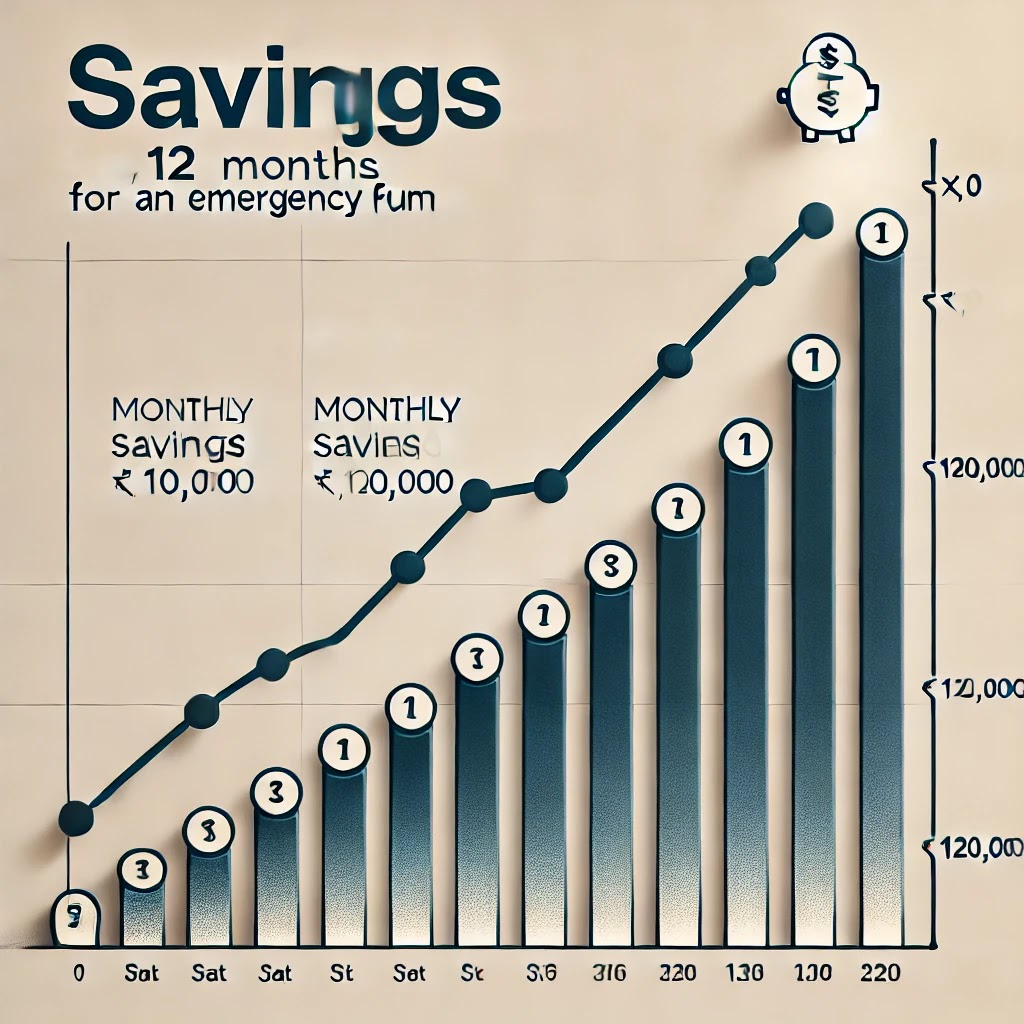
Let’s say you’ve decided to save ₹1,20,000 over the next 12 months. To achieve this, you would need to save ₹10,000 per month. You can break this down further by cutting discretionary expenses or increasing your income to meet the monthly target.

Image Example: A graph showing savings progression from ₹0 to ₹1,20,000 over 12 months.


Where to Keep Your Emergency Fund

Your emergency fund should be kept in a liquid, accessible account. Here are a few options:

  • High-Interest Savings Account: Provides easy access to funds while earning interest.
  • Money Market Account: Another safe and liquid option with a slightly higher interest rate than a regular savings account.
  • Liquid Mutual Funds: For slightly better returns than savings accounts, you can park your emergency fund in liquid mutual funds. Just ensure they are easily redeemable without penalties.

Conclusion

Building an emergency fund is the first and most crucial step towards financial stability. Start small, automate your savings, and ensure that the funds are easily accessible. This financial safety net will protect you from falling into debt and help you maintain peace of mind during life's unpredictable events.


If you're ready to start building your emergency fund, subscribe to our blog for more practical tips on managing your personal finances. Let us guide you step-by-step to financial independence!

Learn how to set financial goals that help you plan for short, medium, and long-term success in our next post.

Setting Financial Goals: A Step-by-Step Guide.

Wednesday, September 18, 2024

Why Managing Money is Important for Everyone: An Introduction to Personal Finance


Introduction: Why Personal Finance Matters

Have you ever wondered why some people seem financially secure while others struggle to make ends meet? The answer often lies in one crucial skill: managing money effectively. In today's world, whether you're a student, a working professional, or a retiree, understanding personal finance is the key to building a secure and prosperous future.

In this blog, we’ll explore the importance of managing money, discuss who should prioritize personal finance, and provide actionable steps on how to begin your financial journey. By the end of this guide, you’ll understand why personal finance isn't just for the wealthy—it’s for everyone.


Why Managing Money is Important: The Big Picture

Managing money is not just about paying bills or balancing a checkbook. It’s about gaining control over your financial future and achieving your life goals, whether that’s buying a house, traveling the world, or simply retiring comfortably. Here’s why managing money is essential:

1. Helps You Achieve Financial Freedom

When you manage your money well, you’re in control of your life. You don’t have to rely on others or worry about unexpected expenses. By creating an emergency fund, investing wisely, and saving consistently, you can avoid financial stress.

Example: Let’s say you’re earning ₹50,000 per month. If you save 20% of your income (₹10,000) consistently and invest it with a 7% annual return, in 10 years, you’ll have over ₹17 lakhs. That’s the power of disciplined financial management!

2. Reduces Stress and Anxiety

Financial stress is one of the leading causes of anxiety. By learning to manage money, you can avoid falling into debt, missing payments, or living paycheck to paycheck. Instead, you’ll feel confident knowing that you have a solid plan in place.

3. Prepares You for Emergencies

Life is unpredictable—medical emergencies, car repairs, or job losses can happen at any time. Having a well-managed emergency fund gives you the cushion you need to handle these situations without going into debt.


Who Should Prioritize Personal Finance?

You might be thinking, "I’m young, I don’t have to worry about finances yet." Or, "I’m not rich enough to worry about managing money." But the truth is, that personal finance is for everyone.

1. Students and Young Adults

Starting early is the best way to ensure long-term financial health. Whether you're saving for college, a car, or your first home, good financial habits will set you up for success.

Example: If a 22-year-old starts investing just ₹5,000 a month with a 7% return, by age 40, they’ll have nearly ₹25 lakhs. The earlier you start, the easier it is to build wealth.

2. Working Professionals

In your working years, it’s essential to focus on building wealth, saving for retirement, and paying off any debts. Managing your money now will ensure you have the freedom to enjoy your later years.

3. Families

Raising a family comes with significant financial responsibilities. From education funds to home expenses, understanding personal finance helps families budget wisely and avoid unnecessary debt.

4. Retirees

Even in retirement, managing money is crucial. Retirees must budget carefully to ensure their savings last through their retirement years.


How to Start Managing Your Money: Steps for Success

If you’re new to managing money, the process may seem overwhelming. But with the right steps, anyone can build a solid financial foundation. Here’s how to start:

Step 1: Create a Budget

A budget is the cornerstone of financial management. It helps you track your income, expenses, and savings. By creating a simple budget, you can ensure you’re living within your means.


Simple Budget Breakdown Example:

A pie chart showing the division of income between expenses, savings, and discretionary spending.


  • 50% Needs: Rent, groceries, utilities, and transportation.
  • 30% Wants: Dining out, entertainment, and hobbies.
  • 20% Savings: Emergency fund, retirement, and investments.

Step 2: Set Financial Goals

It’s hard to manage money effectively if you don’t know what you’re working toward. Set specific, measurable, achievable, relevant, and time-bound (SMART) financial goals.

Example:

  • Short-term goal: Save ₹1 lakh for an emergency fund within 6 months.
  • Long-term goal: Save ₹25 lakhs for retirement by age 60.

Step 3: Start Saving and Investing

Saving and investing are the keys to growing your wealth. Whether you’re putting money into a savings account or investing in mutual funds, it’s important to consistently set aside a portion of your income.

  • A graph showing how compound interest grows wealth exponentially over time.


Step 4: Pay Off Debt

If you have debt, especially high-interest debt like credit cards or personal loans, paying it off should be a priority. The interest on these debts can quickly eat into your income, making it harder to save and invest.


Ready to Take Control of Your Finances? Keep Learning!

Now that you understand the importance of managing your money, it's time to take the next step. Dive deeper into personal finance by exploring our upcoming blogs. Each post is designed to guide you toward financial independence, step by step!


Continue Reading the Series:

  1. Day 2: Setting Financial Goals: Who Should Set Goals and How to Make Them Realistic
    Learn how to set SMART financial goals and achieve them with actionable steps.

  2. Day 3: Building a Budget: Mastering the Art of Saving Without Sacrificing
    Discover how to create a budget that balances your needs, wants, and savings for a brighter future.

  3. Day 4: The Power of Compound Interest: Grow Your Wealth Over Time
    Unlock the magic of compound interest and how it can accelerate your financial growth.


Don’t Miss Out: Subscribe to our blog and get notified of new posts every day. Let’s walk this financial journey together!

Sunday, September 15, 2024

7 Ideas to Create Active Income for Wealth Generation

 Introduction:

Building wealth starts with generating active income streams. Active income refers to the money earned through direct involvement, such as working for a salary or running a business. Here are seven actionable ideas to help you get started on your journey to financial independence.


1. Freelancing in Your Field

Freelancing is one of the easiest ways to generate income using your skills. Whether you're a writer, designer, coder, or marketer, freelancing platforms like Upwork, Fiverr, and Freelancer provide opportunities to earn by offering services in your field of expertise.

  • Example: A web developer can earn by building websites for clients or offering maintenance services.

2. Starting a Side Business

Launching a small business based on your passions or market needs can create a steady stream of income. You can start with minimal capital and scale as profits grow.

  • Example: Selling handmade crafts online via Etsy, launching a food delivery service, or starting a social media consultancy are popular side-business ideas.

3. Teaching or Coaching

If you are an expert in a subject or have a specific skill, consider offering lessons or coaching services. This can be done in person or online through platforms like Teachable, Udemy, or Skillshare.

  • Example: A professional in fitness, photography, or business can create paid courses or host webinars to share their expertise.

4. Consulting in Your Area of Expertise

If you have specialized knowledge in a field, consulting is a lucrative way to generate income. Businesses and individuals often need expert advice on legal matters, marketing strategies, accounting, or technology.

  • Example: A financial planner can consult small businesses on financial management, while a digital marketer can help companies enhance their online presence.

5. Real Estate Brokerage or Property Management

If you have an interest in real estate, becoming a real estate agent or property manager can generate active income. This field allows you to earn through commissions on property sales or management fees.

  • Example: Helping clients buy, sell, or rent properties can lead to substantial earnings, especially in a thriving market.

6. Content Creation

If you enjoy creating content, whether it’s videos, blogs, or podcasts, you can monetize it through advertising, sponsorships, and affiliate marketing. Platforms like YouTube, Medium, and Patreon offer ways to turn your passion into income.

  • Example: A YouTuber can earn from ads and sponsorship deals, while a blogger can generate income through affiliate marketing or sponsored posts.

7. Starting a Professional Service

Offering professional services like accounting, legal advice, graphic design, or tutoring can be a reliable income source. You can either work as a freelancer or start your own service firm.

  • Example: A qualified accountant could offer tax preparation services or financial consultations to small businesses.

Conclusion:

Generating active income is the first step toward financial independence and wealth generation. By leveraging your skills, knowledge, and interests, you can create multiple income streams that pave the way to long-term financial growth. Whether you start freelancing, consulting, or launching a small business, these ideas can help you take the first step.

The Ultimate Guide to Financial Planning: Building a Secure Future

 Introduction:

Financial planning is the cornerstone of achieving long-term financial security. Whether you're saving for retirement, a home, or your children’s education, a well-thought-out financial plan can help you reach your goals. This guide covers essential steps in creating a personalized financial plan to add value to your financial future.


1. Set Clear Financial Goals

Start by identifying your short-term, medium-term, and long-term financial goals.

  • Short-term: Saving for a vacation or emergency fund (within 1-2 years).
  • Medium-term: Buying a car, planning a wedding, or a down payment for a home (2-5 years).
  • Long-term: Retirement planning or children's education (5+ years).

Each goal will have a different timeline and risk profile, so structure your savings and investments accordingly.


2. Create a Budget and Track Expenses

A budget helps you control your spending and ensures you save regularly. Use the 50/30/20 rule:

  • 50% of income for needs (rent, utilities).
  • 30% for wants (entertainment, travel).
  • 20% for savings and investments.

By tracking expenses, you can eliminate unnecessary costs and focus on saving toward your goals.


3. Build an Emergency Fund

An emergency fund is your safety net for unexpected expenses, such as medical emergencies, job loss, or car repairs. Aim to save at least 3-6 months of living expenses in a liquid, easily accessible account.


4. Pay Off High-Interest Debt

Debt can weigh down your financial progress, especially high-interest debts like credit cards and personal loans. Prioritize paying off debts with the highest interest rates first, then move to lower-interest debt.


5. Invest for Growth

Investing allows your money to grow and beat inflation. Diversify your investments based on your risk tolerance:

  • Low risk: Fixed deposits, bonds.
  • Medium risk: Mutual funds, balanced funds.
  • High risk: Stocks, real estate, and equity mutual funds.

Start with systematic investment plans (SIPs) to build wealth steadily while minimizing risk exposure.


6. Plan for Retirement Early

The earlier you start planning for retirement, the more you benefit from the power of compounding. Invest in retirement funds like the National Pension System (NPS), Public Provident Fund (PPF), or employer-sponsored plans like the Employee Provident Fund (EPF).

  • Example: If you invest ₹5,000 per month at an annual return of 8%, you'll accumulate over ₹1.5 crore in 30 years.

7. Insurance: Protect Your Wealth

Protect yourself and your family with adequate insurance coverage. This includes:

  • Health Insurance: Covers medical expenses and hospitalization.
  • Life Insurance: Provides financial security to dependents in case of your untimely death.
  • Critical Illness Insurance: Covers major health conditions that might drain your savings.

8. Tax Planning

Minimize your tax liability through smart tax planning. Invest in tax-saving instruments like Equity Linked Saving Schemes (ELSS), PPF, and National Savings Certificates (NSC) under Section 80C.

  • Example: By investing in ELSS, you can save tax and potentially earn higher returns than traditional tax-saving options.

9. Regularly Review and Adjust Your Financial Plan

Financial plans should not be static. Life events like marriage, having children, or buying a house can affect your financial priorities. Regularly review and adjust your strategy based on your changing needs and circumstances.


Conclusion: Achieve Financial Freedom Through Discipline

Financial planning isn't a one-time event but an ongoing process requiring regular assessment and discipline. By setting clear goals, budgeting, investing smartly, and protecting your assets, you can build a secure financial future. Start today and take control of your financial destiny.


Looking to take control of your finances? Subscribe to my blog for actionable tips, tools, and strategies to help you achieve financial freedom!

Friday, September 13, 2024

How to Start Investing in Mutual Funds: A Step-by-Step Guide with Examples

 Introduction:

Investing in mutual funds is a great way to grow wealth over time, even for beginners. This guide walks you through the process of starting your mutual fund investment journey with examples and visuals to make it easier to understand.


Step 1: Determine Your Financial Goals

Before investing, understand your goals—whether it’s buying a house, funding education, or planning for retirement. Your goal will determine the type of mutual fund to choose.

  • Example: For a long-term goal like retirement, consider equity mutual funds for higher returns. For short-term goals, opt for debt funds which are relatively safer.

Step 2: Assess Your Risk Tolerance

Identify how much risk you are willing to take. Risk tolerance depends on factors like age, income, and financial responsibilities.

  • Example: A 25-year-old with no dependents might choose a high-risk equity fund, while a 50-year-old planning for retirement may prefer a balanced or debt fund.

Step 3: Choose the Right Type of Mutual Fund

Understand the different types of mutual funds: equity, debt, hybrid, and index funds. Select one based on your risk tolerance and investment horizon.

  • Example: If you want exposure to the stock market, go for an equity fund. If you prefer safer investments, consider debt funds.

Step 4: Select a Fund House and Fund Manager

Research different Asset Management Companies (AMCs) and their fund managers. Look for funds managed by experienced managers with a track record of performance.

  • Example: Compare the historical performance, expense ratio, and fund manager's expertise before choosing a mutual fund.

Step 5: Complete Your KYC Process

Complete the Know Your Customer (KYC) process, mandatory for investing in mutual funds in India. You can do this online or through a fund distributor.

  • Documents Required: PAN card, Aadhaar, bank details, and a passport-sized photograph.

Step 6: Start with a Systematic Investment Plan (SIP)

A SIP allows you to invest a fixed amount regularly, minimizing risk through Rupee Cost Averaging.

  • Example: Invest ₹5,000 monthly in an equity mutual fund. Over time, this disciplined approach can help build a substantial corpus, even in fluctuating markets.

Step 7: Monitor Your Investments Regularly

Keep an eye on your mutual fund performance against its benchmark. Make adjustments based on changes in market conditions or your financial goals.

  • Example: If a fund consistently underperforms, consider switching to a better-performing fund.

Conclusion:

Starting with mutual fund investments can be simple if you understand your financial goals, risk appetite, and the various types of funds available. With a step-by-step approach, you can build a diversified portfolio that aligns with your financial objectives.


Ready to begin your mutual fund journey? Subscribe to my blog for regular updates, insights, and tips on smart investing!

How to Read Mutual Fund Details for Better Understanding

 Introduction:

Investing in mutual funds can be rewarding, but it requires a solid understanding of the fund details to make informed decisions. This blog elaborates on how to read and interpret mutual fund factsheets and key parameters, with practical examples to help you get started.


Key Components to Understand:

1. Fund Objective:

  • Example: The objective of an "Equity Growth Fund" might be "to achieve long-term capital appreciation by investing predominantly in equity and equity-related instruments." If your goal is wealth creation over a long period, this aligns well with your strategy. Conversely, a "Debt Income Fund" might aim for "regular income by investing in fixed-income securities," which suits a conservative investor looking for steady returns.

2. Fund Type and Category:

  • Example: A "Large-Cap Equity Fund" invests mainly in large, established companies with stable growth prospects. An "Aggressive Hybrid Fund," however, may invest 65% in equities and 35% in debt instruments, offering a balance between growth and stability. Understanding these categories helps align your investment choice with your risk tolerance and time horizon.

3. Net Asset Value (NAV):

  • Example: If Fund A’s NAV is ₹30 and Fund B’s NAV is ₹100, this does not mean Fund A is cheaper or better. Instead, consider how the NAV has grown over time. Fund B’s NAV might have grown from ₹10 to ₹100 over 5 years, indicating better performance.

4. Expense Ratio:

  • Example: If Fund C has an expense ratio of 1.5% and Fund D has 0.75%, Fund D is more cost-efficient. Over a 10-year period, assuming both funds give a return of 10% per annum, the lower expense ratio could mean a substantial difference in your final returns.

5. Returns:

  • Example: Fund E shows a 1-year return of 12%, a 3-year annualized return of 10%, and a 5-year annualized return of 8%. If the benchmark index returned 9%, 11%, and 7% over the same periods, Fund E has underperformed in the short term but outperformed over the longer term, indicating it might be better for long-term investment.

6. Risk Measures:

  • Example:
    • Standard Deviation: Fund F has a standard deviation of 18%, indicating higher volatility, while Fund G has 10%, suggesting more stable returns.
    • Beta: Fund H has a Beta of 1.2, meaning it’s 20% more volatile than the market, while Fund I has a Beta of 0.8, indicating it’s 20% less volatile.
    • Sharpe Ratio: Fund J has a Sharpe ratio of 1.5, meaning it offers a better risk-adjusted return compared to Fund K’s ratio of 0.8.

7. Portfolio Composition:

  • Example: If a mutual fund has 40% in technology stocks, 30% in financials, 20% in consumer goods, and 10% in healthcare, it is heavily weighted toward technology. During a tech downturn, the fund may suffer more than a diversified fund with a more balanced sector allocation.

8. Fund Manager and Tenure:

  • Example: If Fund L has been managed by the same fund manager for 10 years and has consistently outperformed its benchmark, it may indicate strong management capabilities. In contrast, a frequent change in fund managers may indicate instability.

9. Exit Load and Lock-in Period:

  • Example: Fund M has an exit load of 1% if redeemed within a year, while Fund N has no exit load. If you may need liquidity soon, Fund N would be a better choice.

10. Minimum Investment and SIP Option:

  • Example: If Fund O requires a minimum lump-sum investment of ₹5,000 or allows an SIP of ₹500 per month, and you are a small investor or a beginner, you might prefer the SIP option to start investing gradually.

Conclusion:

Reading mutual fund details carefully helps you understand what you are investing in, aligning the fund’s characteristics with your financial goals, risk appetite, and investment horizon. Always compare the fund's performance against its benchmark, understand the fee structure, and look at the fund manager's experience to make well-informed decisions.


Ready to explore mutual funds in-depth? Subscribe to my blog for more tips, tools, and strategies on smart investing and achieving your financial goals!

Wednesday, September 11, 2024

Achieving Your FIRE Number: A Detailed Guide with Use Cases

 Introduction:

Financial Independence, Retire Early (FIRE) is a movement where individuals save and invest aggressively to achieve financial freedom sooner. Your "FIRE number" is the amount of money you need to save and invest to live off your returns without working. This blog outlines detailed strategies and use cases to help you achieve your FIRE number.


Understanding Your FIRE Number:

Your FIRE number is typically calculated by multiplying your annual expenses by 25. For instance, if you need ₹6,00,000 annually, your FIRE number is ₹1.5 crore (₹6,00,000 x 25). This amount assumes a 4% safe withdrawal rate from your portfolio, which is considered sustainable over the long term.


Use Cases to Achieve Your FIRE Number:

1. Case Study: Aggressive Savings and Investments

  • Profile: A 30-year-old IT professional, earning ₹15 lakh annually, aiming to retire in 15 years.
  • Strategy:
    • Savings Rate: Save 50% of income (₹7.5 lakh/year).
    • Investment Portfolio: 70% in equity mutual funds, 20% in index funds, 10% in debt funds.
    • Projected Returns: Assuming an average annual return of 10% from equity and 6% from debt, the portfolio can grow to approximately ₹2.5 crore in 15 years.
  • Outcome: Achieves FIRE by maintaining a high savings rate and leveraging the power of compounding through equity investments.

2. Case Study: Passive Income Generation

  • Profile: A 40-year-old entrepreneur, looking for passive income to support retirement.
  • Strategy:
    • Real Estate Investment: Purchase two rental properties worth ₹50 lakh each, generating a combined monthly rental income of ₹50,000.
    • SWP in Mutual Funds: Invest ₹1 crore in a balanced mutual fund with a systematic withdrawal plan (SWP) of ₹30,000/month.
    • Outcome: Total passive income of ₹80,000/month, covering living expenses and allowing for a comfortable retirement without depleting the principal amount.

3. Case Study: Frugal Living and Index Fund Investing

  • Profile: A 35-year-old teacher earning ₹8 lakh annually, adopting a minimalist lifestyle.
  • Strategy:
    • Savings Rate: Save 60% of income (₹4.8 lakh/year) by reducing unnecessary expenses.
    • Investment Portfolio: 100% in low-cost index funds, focusing on long-term growth.
    • Projected Returns: With an 8% average annual return, the portfolio could grow to ₹1.2 crore in 20 years.
  • Outcome: Achieves FIRE by aligning lifestyle choices with investment strategy, focusing on simplicity and low-cost investing.

Steps to Achieve Your FIRE Number:

  1. Calculate Your FIRE Number: Estimate your annual expenses and multiply by 25.
  2. Increase Savings Rate: Aim to save 40-70% of your income.
  3. Invest Wisely: Diversify across equities, bonds, real estate, and index funds.
  4. Create Passive Income Streams: Consider rental properties, dividends, SWPs, etc.
  5. Minimize Expenses: Adopt frugal habits to maximize savings and reduce your FIRE number.

Conclusion:

Achieving your FIRE number requires a combination of aggressive saving, strategic investing, and lifestyle adjustments. Whether you choose to invest in equities, generate passive income, or live frugally, the key is to stay disciplined and focused on your financial goals.


Ready to take control of your financial future? Subscribe to my blog for more insights, strategies, and tools to help you achieve your FIRE number!

Saturday, September 7, 2024

How a Systematic Withdrawal Plan (SWP) Can Create Passive Income

 Introduction:

A Systematic Withdrawal Plan (SWP) is an investment strategy that allows you to withdraw a fixed amount from your mutual fund investments regularly. It provides a steady stream of passive income, making it an ideal choice for retirees or anyone seeking consistent cash flow.


How SWP Works:

SWP enables you to redeem a specific amount or number of units at regular intervals (monthly, quarterly, etc.). Unlike dividends, SWPs offer flexibility and control over the withdrawal amount, helping to manage your finances better.

Example:

  • Invest ₹10 lakh in an equity mutual fund with an average return of 10% p.a.
  • Withdraw ₹5,000 monthly.
  • The remaining investment continues to grow, potentially increasing your corpus over time.

Benefits of SWP:

  1. Regular Income: Ensures a consistent cash flow to cover expenses.
  2. Tax Efficiency: Gains are taxed at favorable rates compared to other income sources.
  3. Flexibility: You can choose the withdrawal amount and frequency.
  4. Capital Preservation: With proper planning, it helps maintain the principal amount.

Conclusion:

An SWP is an effective strategy for generating passive income while keeping your capital invested for growth. It offers both financial stability and flexibility, making it a valuable tool for achieving long-term financial goals.


Interested in learning more about how to set up a SWP for passive income? Subscribe to my blog for expert tips and investment strategies!

Thursday, September 5, 2024

Simple Strategies for Creating Wealth in the Equity Market

Introduction:

Investing in the equity market can be a powerful way to create wealth over time. While it may seem intimidating, using simple strategies can help you navigate the market effectively. This blog explores key strategies for wealth creation through equities.


1. Start with Systematic Investment Plans (SIPs):

SIPs allow you to invest a fixed amount regularly in mutual funds or stocks. This strategy helps in averaging the purchase cost and benefiting from compounding returns. For example, investing ₹5,000 monthly in a diversified equity mutual fund with an average annual return of 12% can grow to around ₹20 lakh in 15 years.

2. Invest in Blue-Chip Stocks:

Blue-chip stocks are shares of large, well-established, and financially stable companies. Companies like Reliance Industries, TCS, and HDFC Bank are known for their strong performance and consistent growth. These stocks often provide steady returns and are less volatile, making them a safer option for long-term wealth creation.

3. Focus on Diversification:

Diversification involves spreading investments across different sectors and companies to reduce risk. By investing in various industries like banking, technology, healthcare, and consumer goods, you can balance potential losses in one sector with gains in another.

4. Follow a Buy-and-Hold Strategy:

A buy-and-hold strategy involves purchasing stocks and holding them for an extended period, regardless of market fluctuations. This approach is based on the belief that quality stocks will grow over time. For example, investing in Infosys or HDFC Bank 20 years ago and holding onto them would have generated substantial returns today.

5. Use the Power of Compounding:

Reinvesting dividends and staying invested over the long term can significantly grow your wealth. Compounding allows your earnings to generate more earnings, leading to exponential growth. For instance, if you invest ₹1 lakh in a stock that grows at 10% annually, in 20 years, your investment could grow to over ₹6.72 lakh due to compounding.

6. Stay Informed and Be Patient:

Staying updated with market trends, news, and company performance helps in making informed investment decisions. Additionally, being patient and avoiding impulsive decisions during market volatility can help you stay on track toward long-term wealth creation.


Conclusion:

Creating wealth in the equity market is not about quick wins but about consistent, informed, and patient investing. By following these simple strategies, you can build a strong foundation for long-term financial success.


Call to Action:

Want to learn more about equity investing and wealth creation? Subscribe to my blog for expert insights, tips, and strategies to achieve your financial goals!


This blog outlines easy-to-understand strategies for beginners and experienced investors to effectively create wealth in the equity market.

Wednesday, September 4, 2024

Top Financial Instruments to Achieve Financial Freedom

 Introduction:

To achieve financial freedom, it's essential to diversify your investments using various financial instruments. Each instrument offers unique benefits, risk levels, and growth potential. This blog will explore the most effective instruments for building a secure financial future.


1. Equity Stocks

Investing in individual stocks allows for capital growth by owning a share of a company's profits. For example, blue-chip stocks like TCS or Reliance Industries offer potential long-term gains.

2. Mutual Funds

Mutual funds pool money from multiple investors to invest in a diversified portfolio of stocks, bonds, or other securities. Systematic Investment Plans (SIPs) in equity mutual funds can help build wealth over time.

3. Fixed Deposits (FDs)

FDs are low-risk investment instruments that provide fixed interest rates over a set period. Ideal for conservative investors, they offer stability and predictable returns.

4. Real Estate

Investing in property can generate rental income and long-term capital appreciation. Real estate offers both immediate cash flow and a hedge against inflation.

5. Public Provident Fund (PPF)

PPF is a government-backed, tax-saving investment with a 15-year lock-in period, providing compound interest and tax benefits under Section 80C of the Income Tax Act.

6. National Pension System (NPS)

NPS is a retirement-focused investment scheme that provides market-linked returns and tax benefits. It helps in creating a pension corpus for retirement.

7. Gold

Gold acts as a hedge against inflation and currency devaluation. Investing in gold ETFs or sovereign gold bonds can provide both security and moderate returns.

8. Exchange-Traded Funds (ETFs)

ETFs track indices like the Nifty 50 or Sensex, offering a diversified investment in a single product. They are cost-effective and provide market exposure with lower management fees.

9. Recurring Deposits (RDs)

RDs are low-risk investments suitable for building savings through monthly contributions. They offer fixed interest rates and are perfect for risk-averse investors.

10. Corporate Bonds and Debentures

These are fixed-income instruments companies issue to raise capital, offering higher returns than government securities but with slightly higher risk.


Conclusion:

Achieving financial freedom requires a well-balanced portfolio of these instruments, aligned with your risk tolerance and financial goals. By strategically using these tools, you can build a path toward a secure financial future.


Call to Action:

Ready to build your path to financial freedom? Follow my blog for more insights and detailed strategies for maximizing wealth through smart investing!

Saturday, August 31, 2024

The Journey to Financial Freedom Through Investing: A Step-by-Step Guide with Examples

 Introduction:

Becoming financially free means having enough income from investments to cover your living expenses without relying on a paycheck. This blog outlines a practical journey to financial freedom, with real-life examples to illustrate the process.


Step 1: Setting Clear Financial Goals

Start by defining what financial freedom means to you. For example, Rakesh, a 30-year-old IT professional, wants to retire by 50 with a monthly passive income of ₹50,000.

  • Goal Calculation:
    Assuming a 4% annual withdrawal rate from investments, Rakesh needs a retirement corpus of ₹1.5 crore.

Step 2: Building an Investment Strategy

Rakesh decides to diversify his investments across different asset classes:

  • Equity Mutual Funds: 60% allocation

    • Investment: ₹15,000 per month via SIP in diversified equity funds
    • Expected Return: 12% per annum
  • Debt Instruments: 20% allocation

    • Investment: ₹5,000 per month in PPF and FDs
    • Expected Return: 7% per annum
  • Real Estate: 20% allocation

    • Plans to invest in a rental property for passive income.

Step 3: Compounding Investments Over Time

Rakesh follows the strategy consistently for 20 years:

  • Equity Mutual Funds Growth:

    • Monthly SIP of ₹15,000 at 12% CAGR grows to approximately ₹1.5 crore.
  • Debt Investments Growth:

    • Monthly investment of ₹5,000 at 7% grows to about ₹30 lakh.
  • Rental Income:

    • Real estate investment provides an additional passive income of ₹15,000 per month.

Total Corpus: ₹1.8 crore + Rental Income = Achieved Financial Freedom!


Step 4: Monitoring and Adjusting the Plan

Rakesh reviews his portfolio annually, reallocating funds based on performance and market conditions. For instance, he switches from underperforming equity funds to better-performing ones and increases debt allocation as he approaches retirement.


Step 5: Staying Disciplined and Committed

Throughout his journey, Rakesh remains consistent with his investments, avoids impulsive decisions, and stays focused on his long-term goal despite market fluctuations.


Conclusion:

The path to financial freedom requires a clear plan, disciplined investing, and smart choices. Start small, stay consistent, and leverage the power of compounding to achieve your financial dreams.

Case Study: Investing in Mutual Funds – A Real-World Example with Numbers

 Introduction:

Investing in mutual funds can be a powerful way to grow wealth, but understanding how it works through real-life examples makes it even clearer. In this case study, we'll look at an individual investor's journey, highlighting key decisions, returns, and outcomes.


Case Study: Mr. Sharma’s Mutual Fund Investment Journey

Background:

  • Investor Profile: Mr. Sharma, is a 35-year-old salaried professional in India.
  • Goal: Save ₹50 lakhs in 15 years for his child’s higher education.
  • Risk Appetite: Moderate, preferring a mix of equity and debt funds.

Investment Strategy:

  1. Fund Selection:

    • Equity Fund: 60% allocation to "ABC Equity Fund" (high-growth, diversified)
    • Debt Fund: 40% allocation to "XYZ Debt Fund" (low-risk, steady returns)
  2. Monthly SIP (Systematic Investment Plan):

    • Amount: ₹10,000 per month in the chosen funds (₹6,000 in Equity, ₹4,000 in Debt).

Performance Overview:

  • ABC Equity Fund:

    • Initial NAV (Net Asset Value): ₹100
    • Average Annual Return: 12%
    • 15-Year NAV Projection: ₹520
  • XYZ Debt Fund:

    • Initial NAV: ₹10
    • Average Annual Return: 7%
    • 15-Year NAV Projection: ₹28

Calculation of Returns:

  • Equity Fund Growth:

    • Invested Amount: ₹6,000 x 12 months x 15 years = ₹10,80,000
    • Future Value: Using the SIP calculator at 12% returns, it grows to ₹23,50,000.
  • Debt Fund Growth:

    • Invested Amount: ₹4,000 x 12 months x 15 years = ₹7,20,000
    • Future Value: Using the SIP calculator at 7% returns, it grows to ₹13,40,000.
  • Total Value After 15 Years:

    • ₹23,50,000 (Equity) + ₹13,40,000 (Debt) = ₹36,90,000

Conclusion:

Despite not reaching his target of ₹50 lakhs, Mr. Sharma’s investment of ₹18 lakhs (₹10,80,000 in equity and ₹7,20,000 in debt) grew to ₹36,90,000 over 15 years, highlighting the importance of compounding, diversification, and a balanced approach in mutual fund investments.

Lessons Learned:

  1. Start Early: Beginning sooner could have allowed Mr. Sharma to achieve his goal through longer compounding periods.
  2. Rebalance Regularly: Adjusting the equity-to-debt ratio based on market conditions might optimize returns.
  3. Review Performance: Regular monitoring and switching to better-performing funds if necessary could yield better outcomes.

Understanding Mutual Funds: A Beginner's Guide for Indian Investors

 Introduction:

Mutual funds are one of India's most popular investment options, offering a balanced approach to growing your wealth. If you're new to investing, this guide will help you understand the basics of mutual funds and how to get started.


1. What are Mutual Funds?

A mutual fund pools money from multiple investors to invest in stocks, bonds, or other securities. It's managed by professional fund managers who aim to provide optimal returns based on the fund's objectives.


2. Types of Mutual Funds in India

  • Equity Funds: Invest primarily in stocks; suitable for long-term growth.
  • Debt Funds: Invest in fixed-income securities like bonds; which are ideal for stable returns.
  • Hybrid Funds: Combine both equity and debt; offer balanced risk and reward.

3. How to Choose the Right Mutual Fund

Consider factors like your financial goals, risk tolerance, and investment horizon. Use tools like mutual fund ratings, historical performance data, and fund manager experience to make an informed choice.


4. Benefits of Investing in Mutual Funds

  • Diversification: Reduces risk by investing in a variety of assets.
  • Professional Management: Experienced fund managers handle your investments.
  • Liquidity: Easy to buy and sell units, providing flexibility.

5. How to Start Investing in Mutual Funds

Open an account with a mutual fund provider or use online platforms like Zerodha, Groww, or Paytm Money. Complete KYC, select a fund, and start with a Systematic Investment Plan (SIP) or lump sum.


Conclusion:

Mutual funds can be a great way to grow your wealth, but understanding the basics is crucial. Start small, stay consistent, and consult a financial advisor to maximize your investments.


Monday, August 12, 2024

5 Simple Steps to Start Saving Money in India

Introduction:

Saving money is crucial to financial stability, yet many find it challenging to begin. Establishing a robust savings habit can pave the way for a secure future in a country like India, where financial priorities vary. Whether you're a student, a working professional, or managing a household, these simple steps will help you start saving money effectively.

1. Set Clear Financial Goals

Before you start saving, define your financial goals. Whether it's an emergency fund, a vacation, or a down payment for a house, having a clear objective makes it easier to stay motivated.

2. Track Your Expenses

Understanding where your money goes is the first step toward saving. Keep a record of your daily expenses using apps or a simple spreadsheet. This will help you identify areas where you can cut back.

3. Create a Budget

Based on your income and expenses, create a budget. Allocate a specific portion of your income to savings. The 50/30/20 rule is a good start: 50% for needs, 30% for wants, and 20% for savings.

4. Automate Your Savings

Set up an automatic transfer from your salary account to a savings account. Automating savings ensures that you save before you spend, making it easier to stick to your goals.

5. Choose the Right Savings Tools

In India, options like Fixed Deposits (FDs), Recurring Deposits (RDs), and Public Provident Fund (PPF) offer good returns with minimal risk. Choose the one that aligns with your goals and time horizon.

Conclusion:

Saving money doesn't have to be daunting. You can build a strong financial foundation by setting clear goals, tracking expenses, creating a budget, automating savings, and choosing the right tools. Start small, stay consistent, and watch your savings grow over time.


Saturday, August 10, 2024

A Beginner’s Guide to Personal Finance for Indians: Laying the Foundation for Financial Success

Introduction:


Managing personal finances effectively ensures a secure and prosperous future in a rapidly evolving economy like India. Whether you're just starting your career, planning for big life events, or looking to build wealth over time, understanding the basics of personal finance is the first step toward financial freedom.


This guide will explore the fundamental aspects of personal finance tailored specifically for Indians. From budgeting and saving to investing and tax planning, this post will provide you with practical tips to start managing your money wisely.

1. Understanding the Basics of Budgeting


Budgeting is the cornerstone of personal finance. It helps you keep track of your income, expenses, and savings, ensuring that you live within your means.


Create a Monthly Budget: Start by listing your sources of income and fixed expenses like rent, EMIs, and utilities. Allocate a portion of your income for savings and investments.

Track Your Spending: Use apps like MoneyControl, Walnut, or Excel sheets to monitor your daily spending. Identifying unnecessary expenses can help you save more.

Emergency Fund: Set aside at least 3-6 months’ worth of expenses in a liquid fund to cover unforeseen events like job loss or medical emergencies.


2. The Importance of Saving: Start Early, Save Often


Saving is the foundation of financial stability. The sooner you start, the more time your money has to grow.


Savings Accounts: Open a high-interest savings account to park your short-term savings.

Recurring Deposits (RDs): Ideal for disciplined savers, RDs allow you to save a fixed amount monthly with decent returns.

Public Provident Fund (PPF): A popular long-term savings option with tax benefits under Section 80C.


3. Introduction to Investing: Let Your Money Work for You

Investing is essential for building wealth over time. Understanding the different investment options available in India will help you make informed decisions.


Mutual Funds: SIPs (Systematic Investment Plans) in mutual funds are a great way to start investing with a small amount. They offer diversification and are managed by professionals.

Stock Market: Directly investing in stocks can be rewarding but comes with higher risk. Ensure you have a good understanding or seek advice from a financial advisor.

Real Estate: Property investment can be lucrative, but it requires substantial capital. Consider it as part of your long-term strategy.

Gold: Gold is a traditional investment in India. Options include physical gold, gold ETFs, or sovereign gold bonds.


4. Tax Planning: Save Money While Complying with the Law


Tax planning is essential to optimize your earnings and take advantage of the deductions available.


Section 80C Deductions: Invest in PPF, ELSS, or life insurance to claim deductions up to ₹1.5 lakh under Section 80C.

Health Insurance: Premiums paid for health insurance can be claimed under Section 80D.

Home Loan Interest: Deduct the interest paid on home loans under Section 24(b).


5. Planning for Retirement: Secure Your Golden Years

It's never too early to start planning for retirement. With the rise in life expectancy, ensuring you have enough funds for your retirement years is crucial.


Employee Provident Fund (EPF): A mandatory savings scheme for salaried individuals, offering decent returns with tax benefits.

National Pension System (NPS): A government-backed retirement savings option that allows you to invest in equity and debt instruments.

Mutual Funds and Annuities: Diversifying your retirement savings across mutual funds and annuities can provide a steady income post-retirement.


Conclusion: Take Control of Your Financial Future

Personal finance is not just about managing money; it's about creating a life that aligns with your financial goals. By understanding the basics of budgeting, saving, investing, and tax planning, you can take control of your financial future and work towards achieving your dreams.

Remember, the journey to financial independence is a marathon, not a sprint. Start small, stay consistent, and you'll see the rewards over time.


The History and Evolution of the Stock Market

Introduction The stock market has been a fundamental pillar of the global economy, evolving over centuries to become the complex financial s...