Friday, September 20, 2024

How to Build an Emergency Fund: Steps to Financial Security and Peace of Mind

Introduction: Why You Need an Emergency Fund


An emergency fund is one of the most important pillars of personal finance. It’s a safety net designed to cover unforeseen expenses such as medical bills, car repairs, or unexpected job loss. Without this financial cushion, you might end up relying on high-interest credit cards or loans, leading to a cycle of debt.

In this blog, we'll discuss why an emergency fund is crucial for everyone, who should prioritize it, and how to start building it today. We'll also provide some practical examples and images to illustrate these points.


Why Is an Emergency Fund Crucial?

  1. Financial Security Life is full of unexpected events, and an emergency fund ensures you can handle these without disrupting your financial stability. Whether it's a sudden illness or home repair, having a buffer prevents you from derailing your long-term financial goals.

  2. Debt Prevention An emergency fund prevents the need for borrowing in case of urgent expenses. Without one, you might have to take on credit card debt or personal loans with high interest rates. Over time, these debts can accumulate and make it difficult to achieve financial independence.

  3. Peace of Mind Knowing you have funds to cover emergencies reduces stress and anxiety. This peace of mind lets you focus on other aspects of life, such as growing wealth or planning for future financial goals.


Who Should Build an Emergency Fund?

Everyone—regardless of their income, job stability, or lifestyle, having an emergency fund is essential.

  • College Students: Even students should have some funds set aside for emergencies like car repairs, medical expenses, or unexpected tuition hikes.
  • Young Professionals: Individuals just starting their careers should aim to build an emergency fund, especially if they live independently or have variable incomes.
  • Families: For households, especially those with children, an emergency fund is critical for covering unforeseen family expenses.
  • Retirees: Even retired need an emergency fund to manage unexpected healthcare or home maintenance costs.

How Much Should You Save?

A general rule of thumb is to save 3 to 6 months of living expenses. This means that if your monthly expenses are ₹40,000, you should aim to have between ₹1,20,000 and ₹2,40,000 in your emergency fund.

  1. Step 1: Calculate your essential monthly expenses:

    • Rent or mortgage
    • Utilities (electricity, water, gas)
    • Groceries
    • Loan or credit card payments
    • Transportation
    • Insurance (health, car, etc.)
  2. Step 2: Multiply the total by 3 to 6 months to determine your emergency fund target.

Example: If your essential monthly expenses are ₹30,000, your emergency fund goal should be between ₹90,000 and ₹1,80,000.


How to Build an Emergency Fund: Step-by-Step

  1. Set a Realistic Goal
    Start with a smaller, more manageable target, such as ₹10,000, and gradually build from there. This helps you stay motivated and avoid feeling overwhelmed.

  2. Automate Your Savings
    One of the easiest ways to build an emergency fund is to automate savings. Set up a recurring transfer from your salary account to a dedicated savings account. Even ₹2,000 a month adds up over time.

  3. Cut Unnecessary Expenses
    Identify non-essential expenses, such as dining out or subscriptions, and temporarily reduce them. Allocate this saved money towards your emergency fund.

  4. Earn Extra Income
    Consider side jobs, freelance work, or selling unused items to boost your emergency savings.


Example of Building an Emergency Fund

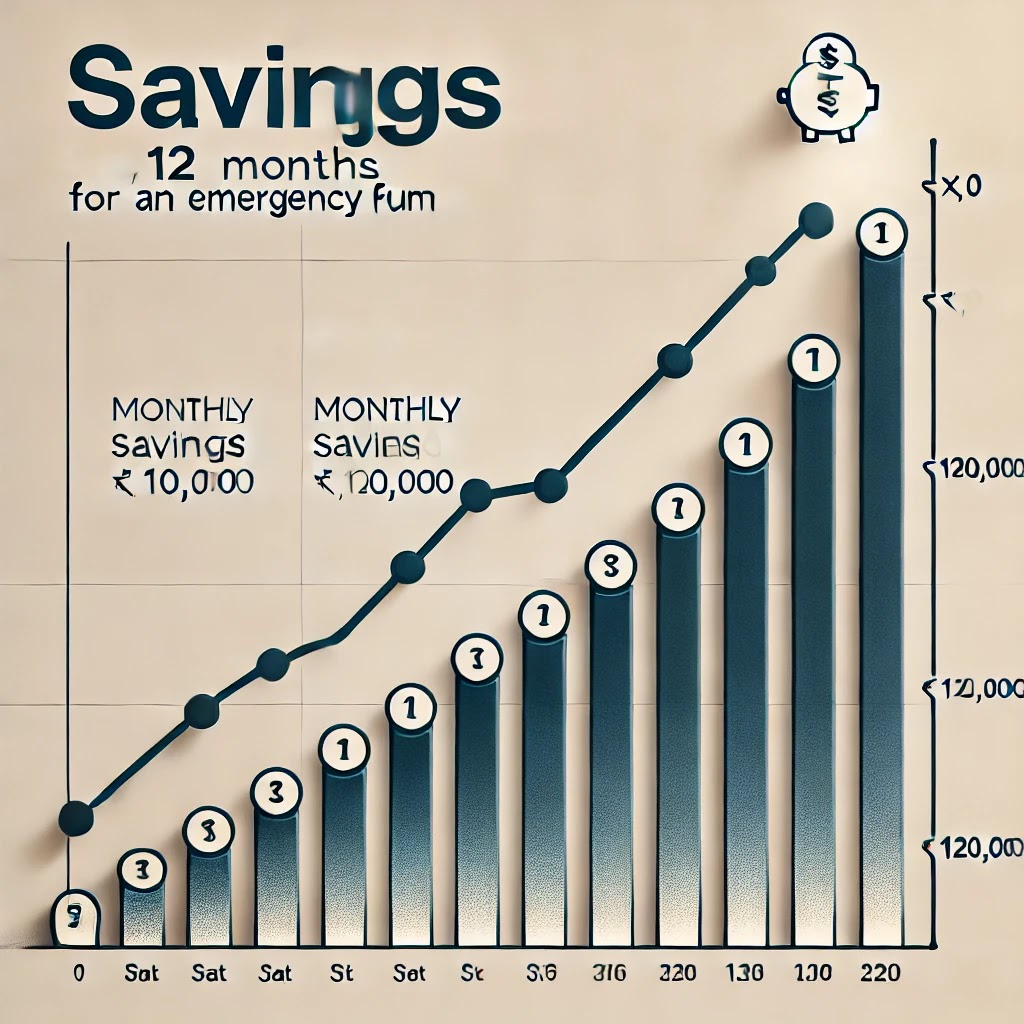
Let’s say you’ve decided to save ₹1,20,000 over the next 12 months. To achieve this, you would need to save ₹10,000 per month. You can break this down further by cutting discretionary expenses or increasing your income to meet the monthly target.

Image Example: A graph showing savings progression from ₹0 to ₹1,20,000 over 12 months.


Where to Keep Your Emergency Fund

Your emergency fund should be kept in a liquid, accessible account. Here are a few options:

  • High-Interest Savings Account: Provides easy access to funds while earning interest.
  • Money Market Account: Another safe and liquid option with a slightly higher interest rate than a regular savings account.
  • Liquid Mutual Funds: For slightly better returns than savings accounts, you can park your emergency fund in liquid mutual funds. Just ensure they are easily redeemable without penalties.

Conclusion

Building an emergency fund is the first and most crucial step towards financial stability. Start small, automate your savings, and ensure that the funds are easily accessible. This financial safety net will protect you from falling into debt and help you maintain peace of mind during life's unpredictable events.


If you're ready to start building your emergency fund, subscribe to our blog for more practical tips on managing your personal finances. Let us guide you step-by-step to financial independence!

Learn how to set financial goals that help you plan for short, medium, and long-term success in our next post.


Setting Financial Goals: A Step-by-Step Guide.

Thursday, September 19, 2024

Setting Financial Goals (Who Should Set Goals and How to Set Realistic Ones)

Introduction: Setting financial goals is critical to achieving financial independence and security. Without clear and actionable goals, it's easy to lose track of your finances and fall short of long-term wealth. In this blog, we'll explore who should set financial goals, how to set realistic ones and share examples to help guide you in your personal financial journey.


Why Setting Financial Goals is Crucial

Financial goals give you direction and purpose. They act as a roadmap for your financial future, helping you manage your spending, save for future expenses, and invest for wealth growth. Whether you're aiming to save for an emergency fund, plan for a big purchase, or secure a comfortable retirement, financial goals help ensure you're on the right track.

Example: Imagine trying to save ₹50,000 in one year without a concrete plan. You’ll likely struggle to get there. Now, if you break it down and set a goal to save ₹4,200 per month, it becomes far more achievable and easier to track.


Who Should Set Financial Goals?

Everyone should set financial goals, regardless of age, income, or financial situation. Here are some profiles:

  • Students: Planning to save for education or side hustles.
  • Young Professionals: Setting short-term goals like creating an emergency fund or saving for a down payment on a house.
  • Families: Managing household budgets, saving for kids' education, and long-term investments.
  • Retirees: Ensuring retirement funds are adequate for future needs.

Example: A young professional earning ₹50,000 per month should set aside 20% for long-term savings and investments while focusing on building an emergency fund.


How to Set Realistic Financial Goals

Setting vague or overly ambitious financial goals can lead to frustration. The best method to ensure success is using the SMART goal framework—goals should be Specific, Measurable, Achievable, Relevant, and Time-bound.

1. Specific

Define exactly what you want to achieve.

  • Example: "Save ₹1,00,000 for an emergency fund" is more specific than "Save money."

2. Measurable

Ensure your goal can be tracked with numbers or milestones.

  • Example: "Save ₹5,000 each month" allows you to track progress toward your ₹1,00,000 goal.

3. Achievable

Set realistic goals based on your financial situation.

  • Example: If you can only afford to save ₹2,500 per month, adjust your timeline or goals.

4. Relevant

Align your goals with your financial priorities.

  • Example: If your priority is financial security, focus on an emergency fund before investing heavily in the stock market.

5. Time-bound

Set a deadline for your goals to motivate you to stay on track.

  • Example: "Save ₹1,00,000 within 12 months."

Breaking Down Financial Goals: Short-Term, Medium-Term, and Long-Term

1. Short-Term Goals (0-2 years)

These are smaller, more immediate goals you can accomplish within a short period.

  • Example: Building an emergency fund of ₹1,00,000 within 1 year.

2. Medium-Term Goals (2-5 years)

These are for milestones within the next few years.

  • Example: Saving for a car or home down payment.

3. Long-Term Goals (5+ years)

These are larger financial objectives that require a long-term commitment.

  • Example: Saving ₹25,00,000 for retirement over 20 years.

Example Use Case: A Step-by-Step SMART Goal for a Young Professional

SMART financial goals framework visual representation showing Specific, Measurable, Achievable, Relevant, and Time-bound steps with icons for saving, time, and goal setting.


  • Specific: Save ₹5,00,000 for a home down payment.
  • Measurable: Save ₹15,000 per month.
  • Achievable: Reduce unnecessary expenses and invest in a high-yield savings account.
  • Relevant: The goal aligns with the individual’s desire to buy a home within the next 5 years.
  • Time-bound: Reach the goal in 3 years.

How to Stay on Track with Financial Goals

  1. Automate Your Savings: Set up automatic transfers to your savings account to ensure you’re consistently saving.
  2. Track Your Progress: Regularly check how close you are to reaching your goal.
  3. Reassess and Adjust: Life changes, and so should your goals. Adjust your financial goals accordingly if you experience a change in income or priorities.

Conclusion: Achieving Financial Success with Clear Goals

Setting realistic and well-defined financial goals is the cornerstone of economic success. With a clear direction and the SMART framework, anyone can take control of their financial future. Whether you're a student just starting out, a young professional managing new income, or a retiree ensuring your funds last, setting goals is the key to staying financially secure.


Ready to take the next step in your financial journey? Subscribe for more tips on budgeting, saving, and investing! And don't miss Day 3, where we’ll discuss creating and sticking to a monthly budget with practical tips and templates.

Wednesday, September 18, 2024

Why Managing Money is Important for Everyone: An Introduction to Personal Finance


Introduction: Why Personal Finance Matters

Have you ever wondered why some people seem financially secure while others struggle to make ends meet? The answer often lies in one crucial skill: managing money effectively. In today's world, whether you're a student, a working professional, or a retiree, understanding personal finance is the key to building a secure and prosperous future.

In this blog, we’ll explore the importance of managing money, discuss who should prioritize personal finance, and provide actionable steps on how to begin your financial journey. By the end of this guide, you’ll understand why personal finance isn't just for the wealthy—it’s for everyone.


Why Managing Money is Important: The Big Picture

Managing money is not just about paying bills or balancing a checkbook. It’s about gaining control over your financial future and achieving your life goals, whether that’s buying a house, traveling the world, or simply retiring comfortably. Here’s why managing money is essential:

1. Helps You Achieve Financial Freedom

When you manage your money well, you’re in control of your life. You don’t have to rely on others or worry about unexpected expenses. By creating an emergency fund, investing wisely, and saving consistently, you can avoid financial stress.

Example: Let’s say you’re earning ₹50,000 per month. If you save 20% of your income (₹10,000) consistently and invest it with a 7% annual return, in 10 years, you’ll have over ₹17 lakhs. That’s the power of disciplined financial management!

2. Reduces Stress and Anxiety

Financial stress is one of the leading causes of anxiety. By learning to manage money, you can avoid falling into debt, missing payments, or living paycheck to paycheck. Instead, you’ll feel confident knowing that you have a solid plan in place.

3. Prepares You for Emergencies

Life is unpredictable—medical emergencies, car repairs, or job losses can happen at any time. Having a well-managed emergency fund gives you the cushion you need to handle these situations without going into debt.


Who Should Prioritize Personal Finance?

You might be thinking, "I’m young, I don’t have to worry about finances yet." Or, "I’m not rich enough to worry about managing money." But the truth is, that personal finance is for everyone.

1. Students and Young Adults

Starting early is the best way to ensure long-term financial health. Whether you're saving for college, a car, or your first home, good financial habits will set you up for success.

Example: If a 22-year-old starts investing just ₹5,000 a month with a 7% return, by age 40, they’ll have nearly ₹25 lakhs. The earlier you start, the easier it is to build wealth.

2. Working Professionals

In your working years, it’s essential to focus on building wealth, saving for retirement, and paying off any debts. Managing your money now will ensure you have the freedom to enjoy your later years.

3. Families

Raising a family comes with significant financial responsibilities. From education funds to home expenses, understanding personal finance helps families budget wisely and avoid unnecessary debt.

4. Retirees

Even in retirement, managing money is crucial. Retirees must budget carefully to ensure their savings last through their retirement years.


How to Start Managing Your Money: Steps for Success

If you’re new to managing money, the process may seem overwhelming. But with the right steps, anyone can build a solid financial foundation. Here’s how to start:

Step 1: Create a Budget

A budget is the cornerstone of financial management. It helps you track your income, expenses, and savings. By creating a simple budget, you can ensure you’re living within your means.


Simple Budget Breakdown Example:

A pie chart showing the division of income between expenses, savings, and discretionary spending.


  • 50% Needs: Rent, groceries, utilities, and transportation.
  • 30% Wants: Dining out, entertainment, and hobbies.
  • 20% Savings: Emergency fund, retirement, and investments.

Step 2: Set Financial Goals

It’s hard to manage money effectively if you don’t know what you’re working toward. Set specific, measurable, achievable, relevant, and time-bound (SMART) financial goals.

Example:

  • Short-term goal: Save ₹1 lakh for an emergency fund within 6 months.
  • Long-term goal: Save ₹25 lakhs for retirement by age 60.

Step 3: Start Saving and Investing

Saving and investing are the keys to growing your wealth. Whether you’re putting money into a savings account or investing in mutual funds, it’s important to consistently set aside a portion of your income.

  • A graph showing how compound interest grows wealth exponentially over time.


Step 4: Pay Off Debt

If you have debt, especially high-interest debt like credit cards or personal loans, paying it off should be a priority. The interest on these debts can quickly eat into your income, making it harder to save and invest.


Ready to Take Control of Your Finances? Keep Learning!

Now that you understand the importance of managing your money, it's time to take the next step. Dive deeper into personal finance by exploring our upcoming blogs. Each post is designed to guide you toward financial independence, step by step!


Continue Reading the Series:

  1. Day 2: Setting Financial Goals: Who Should Set Goals and How to Make Them Realistic
    Learn how to set SMART financial goals and achieve them with actionable steps.

  2. Day 3: Building a Budget: Mastering the Art of Saving Without Sacrificing
    Discover how to create a budget that balances your needs, wants, and savings for a brighter future.

  3. Day 4: The Power of Compound Interest: Grow Your Wealth Over Time
    Unlock the magic of compound interest and how it can accelerate your financial growth.


Don’t Miss Out: Subscribe to our blog and get notified of new posts every day. Let’s walk this financial journey together!

Monday, September 16, 2024

Essential Terms in the Indian Stock Market: Use Cases, Examples, and Their Impact on Investments

Understanding the essential terms in the Indian stock market is crucial for informed investing. Here’s an enhanced guide with practical use cases and examples to help you grasp the significance of these terms.


1. Sensex and Nifty

  • Use Case: You invest in an index fund that tracks the Sensex. As Sensex rises due to positive economic conditions, the value of your investment grows proportionally.

  • Example: If Sensex increases from 50,000 to 60,000, a 20% rise, your investment in a Sensex index fund would similarly grow by around 20%, offering a significant return.

  • Significance: Sensex and Nifty serve as barometers for market sentiment. Investors often compare their portfolio's performance with these indices to gauge success.


2. Bull Market vs. Bear Market

  • Use Case: During a bull market, you invest in growth stocks like Tata Consultancy Services (TCS) or Infosys, expecting their prices to rise.
  • Example: In a bull market, TCS shares may rise from ₹2,000 to ₹2,500, yielding a 25% return. In contrast, during a bear market, you might shift your focus to safe investments like government bonds or defensive stocks such as FMCG companies.
  • Significance: Understanding market phases helps in timing investments effectively to maximize returns or minimize risks.

3. IPO (Initial Public Offering)

  • Use Case: You invest in the Zomato IPO in 2021. Zomato offers shares at ₹76, and the stock lists at ₹125, yielding over 60% returns on the day of listing.
  • Example: An investment of ₹1,00,000 in Zomato at ₹76 per share would result in a portfolio worth ₹1,64,000 after listing at ₹125.
  • Significance: IPOs can offer excellent opportunities for early investors but also carry risks due to initial volatility.

4. Blue-Chip Stocks

  • Use Case: You decide to invest in Reliance Industries as a blue-chip stock for stable, long-term returns.
  • Example: Over a 10-year period, Reliance stock grows at an average annual rate of 12%. A ₹1,00,000 investment in Reliance in 2011 would now be worth around ₹3,10,000, providing steady growth.
  • Significance: Blue-chip stocks are reliable for long-term wealth creation and are a core part of most portfolios.

5. Market Capitalization (Market Cap)

  • Use Case: You are comparing large-cap stocks like HDFC Bank (market cap ₹9 lakh crore) versus mid-cap stocks like Apollo Hospitals (market cap ₹60,000 crore).
  • Example: Large-cap stocks provide stability but lower growth rates, whereas mid-caps may offer higher growth but come with increased risk.
  • Significance: Understanding Market Cap helps you build a diversified portfolio that aligns with your risk tolerance.

6. Dividend Yield

  • Use Case: You invest in ITC, a stock known for its consistent dividend payouts.
  • Example: ITC pays ₹10 as dividends per share, and the stock is priced at ₹200. The dividend yield is 5%, providing a steady income for investors who value cash flow.
  • Significance: Dividend-paying stocks are crucial for those seeking regular income, particularly retirees or conservative investors.

7. P/E Ratio (Price-to-Earnings Ratio)

  • Use Case: You compare HUL with a P/E ratio of 40 to Dabur with a P/E of 30 to assess valuation.
  • Example: Despite HUL being more expensive on a P/E basis, its historical performance and brand value might justify the higher price, helping you make a more informed decision.
  • Significance: P/E ratios help investors judge whether a stock is overpriced or undervalued, guiding buying or selling choices.

8. Volume

  • Use Case: You notice a sudden spike in the volume of Adani Ports, which suggests significant interest from institutional investors.
  • Example: Increased volume from 10 lakh shares to 1 crore in a single day might indicate that large investors are buying, signaling a potential price rise.
  • Significance: High trading volumes indicate strong market interest, which can precede major price movements.

9. Stop-Loss Order

  • Use Case: You set a stop-loss order on your shares of Tata Motors at ₹400, meaning the stock will be sold automatically if it drops below this level.
  • Example: If Tata Motors’ price falls from ₹450 to ₹390, your stop-loss triggers at ₹400, preventing further losses.
  • Significance: Stop-loss orders help in minimizing losses, particularly in volatile markets.

10. Derivatives: Futures and Options

  • Use Case: You use a call option to speculate on Infosys stock, expecting the price to rise.
  • Example: You buy a call option for Infosys with a strike price of ₹1,500. If Infosys rises to ₹1,600, you profit from the price difference, but if it drops below ₹1,500, you lose only the premium paid.
  • Significance: Derivatives provide opportunities for hedging, speculation, and leveraged profits but also come with high risk.

11. Mutual Funds

  • Use Case: You invest ₹5,000 per month in an equity mutual fund through a Systematic Investment Plan (SIP).
  • Example: After 10 years of regular SIP investments, assuming an annual return of 12%, your total investment of ₹6,00,000 would grow to around ₹11,60,000, almost doubling your capital.
  • Significance: Mutual funds offer a diversified, professionally managed way to build wealth over time.

Conclusion

Understanding these key terms and their practical applications is crucial for any investor in the Indian stock market. With real-world examples, you can now better grasp how these terms impact investment decisions and market strategies. The stock market offers immense opportunities for wealth creation, provided you are equipped with the right knowledge.


For more insights and in-depth strategies to maximize your returns, subscribe to my blog today and take your investment journey to the next level!

The Evolution of the Indian Stock Market: Key Events That Shaped Its Growth

 The Indian stock market has a rich and dynamic history that spans over a century, influencing the nation’s economic landscape. From its humble beginnings in the 19th century to becoming one of the most important financial markets globally, the journey of the Indian stock market is filled with significant events.


1. The Origin: The Birth of the Bombay Stock Exchange (BSE) – 1875

The history of the Indian stock market can be traced back to 1875 when the Bombay Stock Exchange (BSE) was established, the oldest stock exchange in Asia. A group of 22 stockbrokers would meet under a banyan tree in front of Mumbai's Town Hall, eventually forming a more formal exchange, known as the Native Share and Stock Brokers Association.

  • Key Milestone: The BSE was officially recognized in 1957 under the Securities Contracts Regulation Act, providing more structure to trading.

2. The Formation of the National Stock Exchange (NSE) – 1992

In the 1990s, India's financial markets saw significant reforms with establishing the National Stock Exchange (NSE) in 1992, marking a major shift toward modern, electronic trading systems.

  • Why it Matters: NSE introduced a fully automated, screen-based trading system and an order-driven market, creating transparency and efficiency.
  • Impact: Today, NSE is one of the largest exchanges globally by trading volume and revolutionized retail participation in equity trading.

3. Economic Liberalization – 1991

India's economic liberalization in 1991 transformed the stock market by introducing foreign investments and opening the economy to global markets. These reforms reduced governmental control and introduced private participation, bringing in capital and modern technology.

  • Effect on the Market: Liberalization spurred a boom in market activity, leading to more public companies and international investors entering the scene.

4. The Harshad Mehta Scam – 1992

One of the most infamous events in the Indian stock market history was the Harshad Mehta Scam. Harshad Mehta, a stockbroker, manipulated the market using banking loopholes, inflating stock prices artificially. The scam involved defrauding banks of ₹5,000 crore and led to a significant stock market crash.

  • Aftermath: This scandal triggered reforms in market regulations, leading to the establishment of the Securities and Exchange Board of India (SEBI) as the primary market regulator, enhancing transparency and accountability in trading practices.

5. The Dot-Com Bubble – 2000

The Dot-Com Bubble was a global event, but it had a profound impact on Indian markets as well. With the rise of internet-related companies, stocks of tech companies skyrocketed, only to crash dramatically in the early 2000s.

  • Impact on India: Many tech-based Indian companies saw their stock prices plummet, causing a significant market downturn. This event highlighted the risks of speculative investments.

6. The 2008 Global Financial Crisis

The global financial crisis of 2008 triggered by the collapse of Lehman Brothers in the U.S. sent shockwaves through markets worldwide, including India. The Sensex plunged by nearly 60% from its peak, eroding massive amounts of wealth.

  • Recovery: The Indian market slowly recovered with the help of stimulus packages and reforms, highlighting the resilience of the Indian economy.

7. Demonetization and Market Response – 2016

On November 8, 2016, the Indian government demonetized ₹500 and ₹1,000 banknotes, aiming to curb black money and promote digital transactions. While the initial market reaction was volatile, the move eventually directed more money into formal financial channels, boosting equity markets.


8. The COVID-19 Pandemic and Market Recovery – 2020

The COVID-19 pandemic led to unprecedented volatility in global financial markets, with India’s Sensex crashing nearly 40% in March 2020. However, the markets rebounded strongly due to government stimulus, strong corporate earnings, and a surge in retail investor participation.

  • Example: By the end of 2021, Indian markets hit record highs, with the Sensex crossing 60,000 points for the first time in history.

Conclusion: A Constantly Evolving Market

The Indian stock market has undergone tremendous changes, from manual trading under a banyan tree to a digitized, globally integrated financial system. Key events such as the liberalization in 1991, scams like the Harshad Mehta episode, and major crises like the 2008 meltdown have shaped the market into what it is today.

As more individuals enter the market, both retail and institutional, the stock market remains a cornerstone of wealth generation for millions of Indians, offering both opportunities and lessons in financial discipline.


To stay updated on the latest market trends, subscribe to my blog and learn how to navigate the ever-evolving stock market for your financial benefit.

Achieving Financial Independence: Practical Strategies and Use Cases

 Introduction:

Financial independence means having enough income to cover your living expenses without needing to work actively. It's the freedom to make life choices without being constrained by financial obligations. Let’s explore how to achieve financial independence with practical strategies and real-life use cases.


1. The Path to Financial Independence

The journey to financial independence involves creating multiple income streams, controlling expenses, and investing wisely. Here are the key steps:

  • Create a Financial Plan: Assess your current financial state and establish clear goals.
  • Save Aggressively: Increase your savings rate by cutting unnecessary expenses.
  • Invest Early and Often: Regular investing in equities, mutual funds, and other assets grows wealth over time.
  • Diversify Income: Explore passive income streams like real estate, dividend stocks, and side businesses.

2. Use Case 1: The FIRE Movement

The Financial Independence, Retire Early (FIRE) movement emphasizes extreme savings and investments to retire decades earlier than the traditional retirement age.

  • Example: A 30-year-old software engineer earns ₹15 lakh per year and saves 60% of their income. By investing consistently in index funds and maintaining low living expenses, they aim to retire at 40 with a portfolio large enough to sustain annual withdrawals equal to their needs.

3. Use Case 2: Dividend Investing for Passive Income

Dividend investing is another powerful strategy to achieve financial independence. By investing in companies that pay regular dividends, you can create a passive income stream.

  • Example: An investor builds a diversified portfolio of blue-chip stocks that pay regular dividends. With an investment of ₹50 lakh, earning an average annual dividend yield of 4%, the investor receives ₹2 lakh in passive income yearly. Combined with other investments, this helps cover their living expenses.

4. Use Case 3: Real Estate for Financial Independence

Real estate investing can be an effective way to build wealth and achieve financial freedom. Rental properties provide steady cash flow, and property values tend to appreciate over time.

  • Example: A 40-year-old professional buys rental properties with an upfront investment of ₹1 crore. With monthly rental income of ₹50,000 after expenses, they generate a reliable passive income stream. Over time, they use the cash flow to invest in more properties, further boosting income.

5. Use Case 4: Side Hustles for Active Income Growth

Starting a side hustle can accelerate your journey to financial independence by boosting your active income.

  • Example: A teacher begins offering online tutoring as a side hustle, earning an additional ₹30,000 per month. By investing this extra income into mutual funds, they build a sizable portfolio over the years, helping them achieve financial independence faster.

6. Balancing Risk and Safety: A Strategy for Growth

One of the essential components of financial independence is managing risk. Diversifying investments, regularly reviewing your portfolio, and balancing high-risk, high-return investments with safer options are critical to achieving stability while growing wealth.

  • Example: A middle-aged investor splits their portfolio into equity mutual funds for growth, government bonds for safety, and real estate for passive income. This balanced approach ensures they can weather market volatility without jeopardizing their long-term goals.

Conclusion: Your Financial Independence Blueprint

Achieving financial independence is possible through disciplined saving, strategic investments, and building multiple income streams. Whether through the FIRE movement, dividend investing, real estate, or a side hustle, you can take control of your financial future and enjoy the freedom that comes with it.


Ready to start your journey to financial independence? Subscribe to my blog for actionable tips, insights, and strategies to grow your wealth and achieve financial freedom.

Sunday, September 15, 2024

5 Books to Change Your Money Beliefs and Create Wealth: A Detailed Guide

 Our beliefs about money can either propel us toward financial freedom or hold us back from achieving our financial goals. If you're struggling to build wealth, it could be due to limiting beliefs about money that are rooted in fear, insecurity, or misinformation. To break free of these barriers, here are five essential books that can transform your money mindset and provide practical guidance on building wealth. Let’s explore each book in detail, along with examples to give you a glimpse of their profound teachings.


1. "The Psychology of Money" by Morgan Housel

This book highlights the emotional and psychological aspects of money management. Unlike traditional personal finance books, which focus purely on strategy, Housel delves into how emotions, biases, and behavior drive financial decisions. He emphasizes that being good with money is more about behavior than knowledge.

Key Takeaway:
Your financial success depends more on how you handle money emotionally than on technical financial expertise.

Example:
One of the core lessons is learning to be content with "enough." Housel tells the story of a wealthy businessman who asked a hedge fund manager how it felt to earn millions. The answer: "I have enough." This mindset shift is crucial to avoid chasing endless wealth, leading to better long-term financial decisions.


2. "The Millionaire Next Door" by Thomas J. Stanley and William D. Danko

Contrary to popular belief, most millionaires are not flashy spenders living in mansions. Instead, they are ordinary people living below their means, consistently saving and investing. This book provides a detailed study of the habits of self-made millionaires, showing that accumulating wealth comes from disciplined choices over time.

Key Takeaway:
Wealth is built through frugality, discipline, and strategic investments—not high salaries or luck.

Example:
In the book, the authors introduce a millionaire couple who never earned six-figure salaries, yet accumulated substantial wealth by consistently living below their means, investing wisely, and avoiding status symbols like expensive cars and houses.


3. "The Automatic Millionaire" by David Bach

David Bach's book focuses on automating your finances, so you don't have to rely on willpower to save or invest. He introduces the concept of "paying yourself first" by automatically allocating a portion of your income to savings and investments before you even see it. This approach makes wealth-building almost effortless.

Key Takeaway:
The secret to financial freedom is automating your savings and investments, so they happen without constant effort.

Example:
Bach shares the story of Jim and Sue McIntyre, a middle-class couple who, despite earning modest salaries, became millionaires by automating their savings. Every month, 15% of their income was automatically invested, leading them to build a seven-figure portfolio over time.


4. "The Richest Man in Babylon" by George S. Clason

Written as a series of parables set in ancient Babylon, this classic book teaches timeless financial principles. The stories are simple, yet they contain powerful lessons on saving, investing, and financial discipline that remain relevant today.

Key Takeaway:
The book emphasizes the "Seven Cures for a Lean Purse," which includes saving at least 10% of your income, living below your means, and making your money work for you through investments.

Example:
The parable of Arkad, the richest man in Babylon, shows how he built his wealth by saving a portion of everything he earned and investing it wisely. His journey is a clear example of how consistent saving and wise investments can lead to financial freedom, no matter your income.


5. "Broke Millennial" by Erin Lowry

Targeted at millennials, this book covers practical advice on navigating the modern financial landscape, including how to manage student loans, understand credit, and start investing. Erin Lowry’s conversational style makes the financial world accessible to young professionals who might feel overwhelmed by the complexity of managing money.

Key Takeaway:
Millennials face unique financial challenges, but with the right strategies, they can still build a secure financial future.

Example:
Lowry explains the importance of understanding your spending habits through apps and budgeting tools. She shares the story of a millennial who, by tracking their spending and cutting unnecessary expenses, managed to pay off student loans and start investing in a diversified portfolio.


Conclusion: Break Free from Limiting Money Beliefs

These five books offer more than just financial advice—they challenge the mindset that often holds people back from achieving wealth. Whether it's emotional biases, the temptation to keep up with societal pressures, or a lack of knowledge on how to get started, each of these books provides the tools and strategies you need to transform your financial habits and beliefs.

By applying the lessons from these books, you can reframe how you view money and start building a path toward lasting financial freedom.


Ready to change your money mindset and start creating wealth? Pick up one of these books today and begin your journey toward financial independence. Don’t forget to subscribe to my blog for more tips and book recommendations!

https://amzn.in/d/75SdMdF

https://amzn.in/d/2Tu3s19

The History and Evolution of the Stock Market

Introduction The stock market has been a fundamental pillar of the global economy, evolving over centuries to become the complex financial s...